offline
- Vladimir

- Prijatelj foruma

- Pridružio: 10 Feb 2005
- Poruke: 3549
|
Ovde se kace sve teme vezane za komete,asteroide,meteore
Eros
Scientists have stumbled on a way to passively monitor the shaking of an asteroid to learn what it is made of.

A new study of four-year-old data from NASA's NEAR-Shoemaker mission indicates that a set of vibrations caused by a collision with another space rock played a major role in sculpting the surface of asteroid Eros.
The idea was first put forth in 2001, but it was speculative. Now, an outside expert says, they hypothesis is solid as a rock, and it tells a story of Eros' composition.
Importantly, similar analyses could be used to passively peek inside other space rocks.
Eros is 20 miles (33 kilometers) long and about 8 miles (13 kilometers) wide. It is the most well studied asteroid. NEAR-Shoemaker mapped Eros in detail back in 2000-2001 before officials executed a controlled and dramatic crash landing, the first-ever touchdown on an asteroid.
Like any asteroid, Eros has been banging around the solar system in some form for about 4.5 billion years.
In the early days of the solar system, when things were more crowded, collisions were frequent. Some large asteroids become smaller. Some small rocks stuck together and grew. Many were scooped up by the fledgling Earth and the other planets.
The asteroids that remain, confined mostly to a belt between Mars and Jupiter, harbor a tale of the solar system's formation. But first scientists have to figure out how to read their language, with an alphabet of craters and razbijacs and a grammar based largely on mineral composition and density.
Among Eros' most striking features is an impact crater 4.7 miles (7.6 kilometers) wide that scientists have determined was carved fairly recently. Another curious aspect to Eros is that across nearly 40 percent of its surface, all craters up to about a third of a mile (0.5 kilometers) wide have been erased.
The smooth surface has puzzled scientists since the NEAR landing.
The new study, led by Cornell University researcher Peter Thomas, nixed one theory by determining that the vanished craters could not have been covered by material ejected in the recent large impact. Further, the locations of the erased craters suggests they were jiggled out of existence by the internal vibrations caused in the impact.
The hypothesis, if right, can be used to glean an idea of how the asteroid is constructed. Scientists have long wondered if asteroids were solid rocks or, as is likely in at least some cases, loose piles of rubble that have undergone many collisions and managed to hang together.
"Our observations indicate that the interior of Eros is sufficiently cohesive to transmit seismic energy over many kilometers, and the outer several tens of meters [yards] of the asteroid must be composed of relatively non-cohesive material," Thomas and his colleague, Mark Robinson of Northwestern University, write in the July 21 issue of the journal Nature.
That outer non-cohesive stuff would be regolith, which on Earth is called dirt and on our nearest natural satellite is known as Moon dust.
"For the first time, the authors provide convincing evidence that makes this conclusion more than just reasonable conjecture," says Erik Asphaug, a scientist at the University of California, Santa Cruz who was not involved in the study.
The results confirm what Thomas first suspected back in 2001 and what University of Arizona's James Richardson Jr. found in separate work last year.
The findings are likely to remake the way asteroids are studied.
Scientists have used craters as a way to figure out how ancient or fresh a space rock's surface is. Myriad small craters suggest a long history and thus an old surface. A smoother surface with fewer craters would imply a rock had recently been cleaved or somehow resurfaced.
At least that was the thinking.
"This asteroidal Botox calls into question the habit of dating asteroid surfaces through their cratering record," Asphaug writes in a separate analysis in the journal.
A rubble pile, Asphaug explains, would dampen vibrations during an impact. That would leave more small craters intact, causing the asteroid to appear older based on the conventional method of analysis.
Eros, while it has a deep surface of loose material, is solid enough on the inside, at least in parts, to transmit seismic waves efficiently.
If convention is indeed overturned, the shift could be a boon to space rock studies.
The finding suggests large and newer impact craters, like the one on Eros, could be used as proxies for seismic data, Asphaug points out. The insides of other asteroids might be probed just by mapping their surfaces. "Thomas and Robinson's work also opens up a new way of looking at asteroids," he said.
Perhaps the passive technique could even go active.
Given the success of NASA's recent Deep Impact mission, which crashed a small probe into a comet, Asphaug sees value in a similar project that would first place seismic sensors on a space rock, so that the interior could be mapped during the collision.
Pogledaj
Asteroidi
Asteroids are material left over from the formation of the solar system. One theory suggests that they are the remains of a planet that was destroyed in a massive collision long ago. More likely, asteroids are material that never coalesced into a planet. In fact, if the estimated total mass of all the asteroids was gathered into a single object, the object would be less than 1,500 kilometers (932 miles) across - less than half the diameter of the Moon.
Thousands of asteroids have been identified from Earth. It is estimated that 100,000 are bright enough to eventually be photographed through Earth based telescopes.
Much of our understanding about asteroids comes from examining pieces of space debris that fall to the surface of Earth. Asteroids that are on a collision course with Earth are called meteoroids. When a meteoroid strikes our atmosphere at high velocity, friction causes this chunk of space matter to incinerate in a streak of light known as a meteor. If the meteoroid does not burn up completely, what's left strikes Earth's surface and is called a meteorite. One of the best places to look for meteorites is the ice cap of Antarctica.
Of all the meteorites examined, 92.8 percent are composed of silicate (stone), and 5.7 percent are composed of iron and nickel; the rest are a mixture of the three materials. Stony meteorites are the hardest to identify since they look very much like terrestrial rocks.
Since asteroids are material from the very early solar system, scientists are interested in their composition. Spacecraft that have flown through the asteroid belt have found that the belt is really quite empty and that asteroids are separated by very large distances.
The impact of a large asteroid can be truly catastrophic. For example some believe that the object that smashed into the Yukatan Peninsula 65 million years ago was the event that wiped out the dinosaurs. The Gulf of Mexico may mark the crater that it left behind. The asteroid that would have hit there would have been between 10-20 miles across. The hole in created was about 20 miles deep. It was converted instantly in white hot vapor as was its target and its surrounded areas.
A large asteroid hitting the earth would create debis that would crash down in neighboring areas. It would throw dust into the earth's atmosphere circling the globe, dimming the sunlight, ruining agriculture year round, probably ending civilization as we know it.
At this point in time NORAD has a limited number of people monitoring the skies for asteroids. An asteroid would come in quickly. Asteroids must be tracked.
Space Guard is an international network of telescopes where people work together to track asteroids and divert them from hitting the earth. Blowing up an asteroid is not the answer as large pieces still would impact on the earth and do lots of damage anyway.
The Earth is continually encountering interplanetary debris of various sizes. Although the rarity increases with size, we know there are asteroids big enough to cause a catastrophe if they collided with the Earth. Because of the perturbing influence of the major planets, the asteroid orbits tend to "wander", and the calculation of whether (or when) a particular object might impact the Earth may require extremely accurate knowledge of the orbit, such as can be provided by radar observations.
The solar system has a large number of rocky and metallic objects that are in orbit around the Sun but are too small to be considered full-fledged planets. These objects are known as asteroids or minor planets. Most, but not all, are found in a band or belt between the orbits of Mars and Jupiter. Some have orbits that cross Earth's path, and there is evidence that Earth has been hit by asteroids in the past. One of the least eroded, best preserved examples is the Barringer Meteor Crater near Winslow, Arizona.
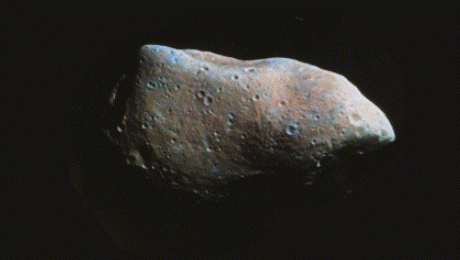
ASTEROID GASPRA #951
ASTEROID IDA #246
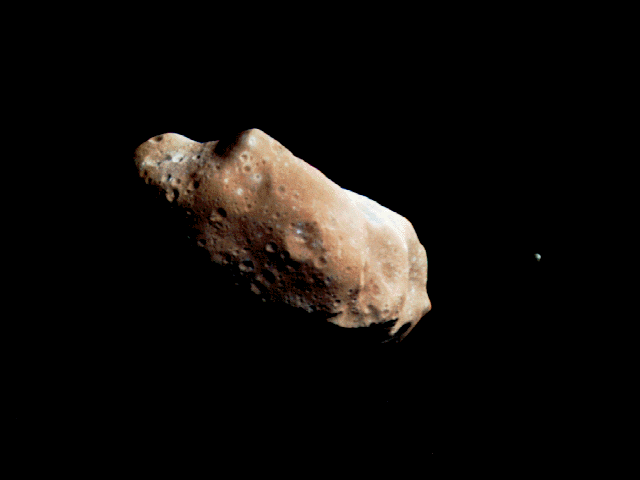
Ida, like Gaspra, is an S-type asteroid, meaning that it is a reddish object composed of a mixture of the minerals pyroxene, olivine, and iron. Approximately one-sixth of all known asteroids fall within the S-type category. Gaspra and Ida like other S-class asteroids are the parent bodies of some types of basaltic meteorites. The Galileo sent back pictures of main-belt asteroids (Gaspra and Ida) during the mission's cruise to Jupiter.
Pojas asteroida
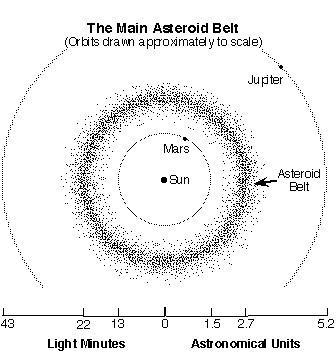
A countless number of asteroids are distributed around the sun. The doughnut shaped concentration of these found between the orbits of Mars and Jupiter is referred to as the asteroid belt.
Asteroid belt estimated to contain over 1 million asteroids with diameter exceeding one kilometer.

The Ceres Asteroid is the largest in the asteroid belt. Asteroids contained within this belt generally orbit the Sun in a stable and essentially circular trajectory. However, a portion of asteroids subject to the gravity of Jupiter undergo a changer in orbit toward the center of the solar system. Asteroids which in this manner draw close to the Earth's orbit are referred to as near Earth objects (NEO), and are considered to pose the danger of potential impact with Earth.
Izvor
Komete
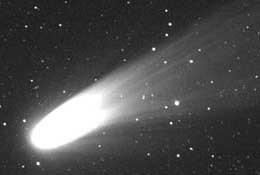
Комете ( грч. kometes- дугокос) се састоје од камења, прашине и гасова, а на њима се могу издвојити два дијела: лоптаста глава или језгро и реп. Језгро комете је величине од 1-2 km и састоји се од леда, прашине и камења. Након што Сунчеви зраци загрију језгро комете, гасови се рашире у облику косе (коме), која заједно са језгром чини главу комете, која достиже и до 100 000 km. Приближавањем Сунцу развија се и реп, чија дужина може бити и до више стотина милиона колометара. Репови комета су дугачки и магличасти, грађени од веома разријеђене прашине и плазме. Још их називају и звијезде репатице. Због веома мале густине за комете се каже да су „огромно видљиво ништа“. У циљу објашњавања густине комета један руски научник је рекао: „Узмите зрно пшенице и одвојите од њега милионити дио. Тај дјелић истуцајте у нејфинију прашину, а затим је разбацајте по некој великој дворани у којој има више од 1000 сједишта. Да ли та количина прашине нешто значи у толикој сали? Ето, толика је управо густина материје у репу комете.“
Комете су видљиве када дођу у близину Сунца и Мјесеца, а њихово појављивање у прошлости људи су тумачили као предзнаке ратова и епидемија. Дијеле се на три основне групе: елиптичне,параболичне и хиперболичне. Комете се састоје од воденог леда, нешто угљеног диоксида, метана и амонијака, те од прашине и стјеновитих честица. Могу се подијелити на кратко-периодичне (до 200 година) и дуго-периодичне (преко 200 г.). Кратко периодичнe се крећу око Сунца истим смјером као и планете, док дуго-периодични могу доћи из било ког смјера. Извор дуго-периодичних комета је Оoртов облак којег чини сферни облак кометских језгри које чине крајњу границу Сунчевог система. Велики број комета као и астероида налазе се у Куиперовом појасу који се налази иза Нептуна. Разлог зашто објекти из Куиперовог појаса никад нису постали небеска тијела је тај што имају мању густину праоблака на великој удаљености од Сунца.
Izvor
Халејева комета
Најпознатија комета је Халејева комета која се појављује у Сунчевом систему сваких 76 година (последњи пут је прошла поред Сунца фебруара 1986. године).До тог закључка дошао је енглески научник Едмонд Халеј у 18.вијеку по коме она и носи име. Сматра се да је ова комета већ 40 пута обилазила око Сунца. Током последњег повратка Халејеве комете извршен је велики научно-истраживачки програм проучавања самог језгра. Двије руске сонде, Вега 1 и Вега 2 прошле су поред језгра комета на око 8000 км и послале су око 1200 фотографија. Европска летилица Гиото прошла је 14. марта 1986.год. на само 540 км од језгра.Тада је утврђено да је језгро црне боје са неколико активних испусних отвора из којих је избацивана велика количина прашине. Само језгро комете је неправилног облика, величине 15 х 8 км.Никада раније није било снимљено језгро комете, а Халејева комета је дала многе одговоре на питања везана уз ова небеска тијела.
Izvor
Meteori
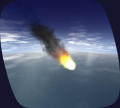
Метеори ( грч. meteoros- лебдећи, висећи) су тамна, мала и хладна небеска тијела која настају распадањем комета и других небеских тијела (астеорида, а постоје и докази да неки метеорити, пронађени на Земљи потичу са Марса). Крећу се појединачно или у ројевима без сталне путање и могу бити различитих величина (од зрнаца прашине до неколико десетина метара). Са Земље видимо метеоре у току ведрих ноћи као звијезде које падају са неба па се нагло угасе или као варнице које прелијећу преко неба.То се дешава када метеори великом брзином улете у Земљину атмосферу, гдје се усијају и испаре усљед трења са ваздухом.
Метеори ( грч. meteoros- лебдећи, висећи) су тамна, мала и хладна небеска тијела која настају распадањем комета и других небеских тијела (астеорида, а постоје и докази да неки метеорити, пронађени на Земљи потичу са Марса). Крећу се појединачно или у ројевима без сталне путање и могу бити различитих величина (од зрнаца прашине до неколико десетина метара). Са Земље видимо метеоре у току ведрих ноћи као звијезде које падају са неба па се нагло угасе или као варнице које прелијећу преко неба.То се дешава када метеори великом брзином улете у Земљину атмосферу, гдје се усијају и испаре усљед трења са ваздухом. Пролазак дијелова космичке материје кроз Земљину атмосферу изазива појаву свјетлог трага који се зове метеор (грч. meteoron-ваздушна појава). Веома мала и невидљива тијела која круже око Сунца у безваздушном простору, називају се метеориди. Када Земља пресјече путању метеорида, он улази у Земљину атмосферу, сагорјева и емитује свјетлост. Та појава се назива метеор. Ако тијело метеорида не сагори у потпуности у атмосфери, оно пада на Земљу остављајући траг у виду кратера.Тијело које падне на површину Земље назива се метеорит. Охлађени метеорити изгледају као „сунђери од зарђалог гвожђа“. Сматра се да на Земљу дневно падну милиони метеорита укупне масе око 15 000kg, који изгледају као киша небеске прашине и камења, појединачне масе мање од 1mg. Метеори се могу подијелити по припадности одређеном метеорском потоку или роју. Метеорски поток је скуп елиптичних метеорида који круже око Сунца, док је метеорски рој скуп згуснутијих метеорских тијела који такође круже око Сунца.
Када Земља пресјече одређени поток или рој чини се као да сви метеори долазе из једне тачке на небу, која се назива радијант (лат. radiare-зрачити). Потоци и ројеви добијају називе у зависности од тога у ком се сазвјежђу или близу које звијезде се њихови радијанти налазе (нпр.Персеиди, Леониди,Геминиди, ета-Аквариди, гама-Дракониди..) Иначе,Геминидима треба око 1.5 до 1.65 година да обиђу Сунце (претпоставља се да они потичу од комете која је прије 15 000 год. посјетила Сунчев систем.)
Метеори који не припадају ни једном потоку или роју зову се спорадици, а веома сјајни метеори који парају небо уз јаку буку зову се болиди.
Брзине метеора крећу се у просјеку од 11km/s до 72km/s. Видљиви траг метеора настаје на 130km од површине Земље, а престаје на око 70km.
Комете приликом проласка кроз Сунчев систем оставе дио свог материјала који се под утицајем гравитације околних небеских тијела групише у меторске потоке или ројеве. Веома ријетка појава дешава се када се комета потпуно распадне и формиора поток који садржи пуно метеорског материјала. Том приликом након проласка Земље поред дотичног потока, може се видјети како метеор сваке секунде запара небо.
Најпознатији су Леониди,крхотине кометеTempel-Tuttl.Пљусак Леонида догађа се сваке године од 14. до 20 .новембра, са максумумом око 17 новембра.
Izvor
Dopuna: 07 Avg 2005 0:36
ESA-ina misija Rosetta - prva letjelica koja će se spustiti na komet
Misija Europske svemirske agencije (ESA-e) pod nazivom Rosetta, bit će prva misija kojoj je cilj spustiti se na komet. Ova je misija vrlo važna jer će nam dati uvid u strukturu i svojstva kometa o kojima ne znamo mnogo
Rosetta will be the first mission ever to land on a comet. After its lander reaches the comet, the main spacecraft will follow the comet for many months as it heads towards the Sun. Rosetta's task is to study comets, which are considered the primitive building blocks of the Solar System. This will help us to understand if life on Earth began with the help of 'comet seeding'.
Rosetta is one of the most challenging missions ever attempted. Many of the complex navigation and landing manoeuvres need to take place automatically with absolutely no room for error. The complications of sending a small spacecraft halfway across the Solar System and making a soft landing on a small comet are immense.
A large number of complex scientific instruments need to be accommodated on one side of the spacecraft, which must permanently face the comet during the operational phase of the mission.
The spacecraft needs to endure both extremes of temperature, from that of deep space to very close to the active comet
Complex spacecraft navigation needs to take place at low-altitude orbits around the dust and gas jets of the comet, which also has a weak but asymmetrical rotating gravity field.
The Rosetta lander has to be stowed to survive the cruise and eventually to self-eject from the spacecraft. The orbiter must navigate with millimetre accuracy for the ejection, and then relay data from the lander back to Earth.
What's special?
Rosetta will be the first space mission to journey beyond the main asteroid belt and rely solely on solar cells for power generation, rather than the traditional radio-isotope thermal generators. The new solar-cell technology used on the orbiter's two giant solar panels allows it to operate over 800 million kilometres from the Sun, where sunlight levels are only 4% of those on Earth. Hundreds of thousands of specially developed non-reflective silicon cells generate up to 8700 Watts in the inner Solar System and around 400 Watts for the deep-space comet encounter
The Rosetta mission will achieve many historic firsts:
Rosetta will be the first spacecraft to orbit a comet's nucleus.
It will be the first spacecraft to fly alongside a comet as it heads towards the inner Solar System.
Rosetta will be the first spacecraft to examine from close proximity how a frozen comet is transformed by the warmth of the Sun.
Shortly after its arrival at the comet, the Rosetta lander will make the first controlled touchdown on a comet nucleus.
Spacecraft
The main spacecraft measures 2.8 x 2.1 x 2.0 metres, on which all subsystems and payload equipment are mounted. There are two 14-metre solar panels with a total area of 64 square metres. At launch, the vehicle weighs approximately 3000 kilograms (fully fuelled) including 1670 kilograms of propellant, 165 kilograms of scientific payload for the orbiter, and 100 kilograms for the lander.
The large number of complex scientific instruments needs to be accommodated on one side of the spacecraft, which must permanently face the comet during the operational phase of the mission. Until its release, the lander is carried on the opposite side of the orbiter to the large high-gain antenna dish.
As it arrives on the comet, the Rosetta lander uses three different techniques (self-adjusting landing gear, harpoons, and a drill) to ensure that once it has arrived on the surface of the comet, it stays there.
As soon as it touches down, two harpoons will anchor the probe to the surface, the self-adjusting landing gear will ensure that it stays upright, even on a slope and then the lander's feet will drill into the ground. These devices will help counteract the fact that there is very low gravity on a comet. The lander will focus on the study of the composition and structure of the comet nucleus material. Goals include the determination of the elements that exist, traces of minerals and isotopic composition of the comet's surface and immediate subsurface. The comet's surface strength, density, texture, porosity, ice phases and thermal properties will also be studied. Texture investigations will include microscopic studies of individual grains.
Journey
The journey to Rosetta's final destination will involve complex fly-bys of other planets.
Partnerships
The orbiter's scientific payload includes 11 experiments and the small lander which is equipped with its own payload of scientific instruments. Scientific consortia from institutes across Europe and the United States have provided these state-of-the-art instruments.
The lander is provided by a European consortium headed by the German Aerospace Research Institute (DLR). Other members of the consortium are ESA, CNES and institutes from Austria, Finland, France, Hungary, Ireland, Italy, and the United Kingdom.
Pogledaj
Dopuna: 08 Avg 2005 23:22
Udar meteora,je start novog zivota
Meteor impacts are generally regarded as monstrous killers and one of the causes of mass extinctions throughout the history of life. But there is a chance the heavy bombardment of Earth by meteors during the planet's youth actually spurred early life on our planet, say Canadian geologists.
A study of the Haughton Impact Crater on Devon Island, in the Canadian Arctic, has revealed some very life-friendly features at ground zero. These include hydrothermal systems, blasted rocks that are easier for microbes to inhabit, plus the cozy, protected basin created by the crater itself. If true, impact craters could represent some of the best sites to look for signs of past or present life on Mars and other planets.
A presentation on the biological effects of impacts is scheduled for Monday, 8 August, at Earth System Processes 2, a meeting co-convened by the Geological Society of America and Geological Association of Canada this week in Calgary, Alberta, Canada.
The idea that meteor impacts could benefit or even create conditions suitable for the beginning of early life struck Canadian Space Agency geologist Gordon Osinski while he and colleagues were conducting a geological survey of the 24-kilometer (15-mile) diameter Haughton Crater. Along the rim of the crater they noticed what looked like fossilized hydrothermal pipes, a few meters in diameter.
"That set the bells ringing about possible biological implications," said Osinski. Hydrothermal systems are thought by many people to be the favourable places for life to evolve."
Detailed mineralogical analyses have since revealed that when the Haughton meteor smacked into the icy ground 23 million years ago it created not only a crater, but fractured the ground in such a way as to create a system of steamy hydrothermal springs reaching temperatures of 250 degrees C. The heat appears to have gradually dropped over a period of tens of thousands of years, the researchers report.
Besides providing heat and razbijacing the ground, the impact also created pore spaces in otherwise dense granitic rocks, giving microbes more access to the minerals and the surfaces inside the rocks - basically more real estate and more supplies.
The shocked rocks are also more translucent, which would be beneficial to organisms that possessing with any photosynthetic capabilities.
A crater shape itself also might serve as a protective environment, says Osinski. As such, impact craters are also good places to store evidence of past life. On Earth many craters fill with water and become lakes. Lakes accumulate sediments, the layers of which are a geological archive of the time after the crater formed. The Haughton Impact crater, for instance, contains the only Miocene-age sediments in the entire Canadian Arctic.
"One of the most interesting aspects of the Haughton Impact Crater is that it's in a polar desert," said Osinski. The dry, frigid weather makes for a barren landscape that's easy to study, he said. The same features make it one of the more Mars-like places on Earth.
"Most people put impacts with mass extinctions," said Osinski. "What we're trying to say is that following the impact, the impact sites are actually more favorable to life than the surrounding terrain."
It's interesting to note, says Osinski, that on Earth the heaviest meteor bombardment of the planet happened at about the same time as life is believed to have started: around 3.8 billion years ago. Impact craters of that age were long ago erased on Earth by erosion, volcanic resurfacing and plate tectonics.
But other planets and moons - including Mars - still bear the cosmic scars of that early debris-clogged period in the solar system. It may be possible, therefore, that the best places to look for at least fossil evidence of life on Mars is inside those very same craters, he said.
"What we're doing is trying to narrow down the search area," said Osinski.
Ovde
|











