|
Poslao: 31 Jul 2009 22:47
|
offline
- tuzor

- Legendarni građanin

- Pridružio: 03 Sep 2007
- Poruke: 4115
- Gde živiš: U Kraljevstvu duha
|
Tačno tako.
[Link mogu videti samo ulogovani korisnici]
Jelkice, izvoli! 
|
|
|
|
|
Registruj se da bi učestvovao u diskusiji. Registrovanim korisnicima se NE prikazuju reklame unutar poruka.
|
|
|
Poslao: 31 Jul 2009 23:47
|
offline

- Pridružio: 07 Avg 2008
- Poruke: 2528
- Gde živiš: VII kat
|
Tuzore, hvala! 
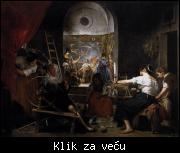
Dugo se smatralo da je ovo obična žanr scena, ali tema slike je alegorijska i u vezi je sa mitom u kom je Atena kaznila jednu takmičarski nastrojenu smrtnicu pretvorivši je u .... Španski slikar.
|
|
|
|
|
|
|
Poslao: 01 Avg 2009 06:53
|
offline
- tuzor
- Legendarni građanin
- Pridružio: 03 Sep 2007
- Poruke: 4115
- Gde živiš: U Kraljevstvu duha
|
Dijego Velaskez, Prelje, odnosno Tkalje, odnosno Priča o Arahni (Las Hilanderas - The Spinners, The Fable of Arachne).
Citat:The goddess Athena, disguised as an old woman, is on the left and Arachne, in a white top facing away from the viewer, is on the right. Three helpers assist them. In the background, a raised platform (perhaps a stage) displays the finished tapestries. The one visible to us is Arachne's, showing The Rape of Europa — another Greek myth. This is in fact a copy of Titian's version of the subject, which was in the Spanish royal collection.
The painting has been interpreted as an allegory of the arts and even as a commentary on the range of creative endeavor, with the fine arts represented by the goddess and the crafts represented by Arachne. Others think that Velázquez' message was simply that to create great works of art, both great creativity and hard technical work are required. Other scholars have read political allegories into the work.
[Link mogu videti samo ulogovani korisnici](Vel%C3%A1zquez)
[Link mogu videti samo ulogovani korisnici](The-Spinners).html
Još jedno kratko objašnjenje slike, i povezanosti motiva sa mitom:
Citat:The tale of Arachne inspired one of Velázquez' most interesting paintings: Las Hilanderas ("The Spinners, or The fable of Arachne", in the Prado), in which the painter represents the two important moments of the myth. In the front, the contest of Arachne and the goddess (the young and the old weaver), in the back, an Abduction of Europa that is a copy of Titian's version (or maybe of Rubens' copy of Titian). In front of it appears Athene in the moment she is punishing Arachne. It transforms the myth into a reflection about creation and imitation, god and man, master and pupil (and therefore about the nature of art).
[Link mogu videti samo ulogovani korisnici]
Nešto više o samom mitu:
Citat:The fable of Arachne is a late Roman addition to Classical Greek mythology, that, of course, does not appear in the myth repertory of the Attic vase-painters. Arachne's name simply means spider (αράχνη). Arachne was the daughter of a famous dyer in Tyrian purple in Hypaipa of Lydia. She became so conceited of her skill as a weaver that she began claiming that her skill was greater than that of Athena herself.
Athena gave Arachne a chance to redeem herself by assuming the form of an old woman and warning Arachne not to offend the deities. Arachne scoffed and wished for a weaving contest, so she could prove her skill.
Athena wove the scene of her victory over Poseidon that had inspired her patronage of Athens. According to the Latin narrative, Arachne's tapestry featured twenty-one episodes of the infidelity of the deities: Zeus being unfaithful with Leda, with Europa, with Danaë.
Athena admitted that Arachne's work was flawless, but was outraged at Arachne's disrespectful choice of subjects that displayed the failings and transgressions of the deities. Finally, losing her temper, Athena destroyed Arachne's tapestry and loom, striking it with her shuttle, Arachne realized her folly and hanged herself. In Ovid's telling, Athena took pity on Arachne who was changed into a spider.
The fable suggests that the origin of weaving lay in imitation of spiders and that it was considered to have been perfected first in Asia Minor.
[Link mogu videti samo ulogovani korisnici]
|
|
|
|
|
|
|
Poslao: 01 Avg 2009 14:51
|
offline
- Pridružio: 07 Avg 2008
- Poruke: 2528
- Gde živiš: VII kat
|
Da, da, sve je tu!
I još samo da dodam par redova iz knjige Baroque, J.R. Martina:
"For Velazquez, master of the ambivalent, the fable is only the central element in a complex allegory of the divine power of the artist and the punishment of human pride. This higher plane of abstract meaning is characteristically approached through the intensely realistic treatment of the shadowed foreground where women are seen carding and spinning wool - an allusion perhaps to the humbler, mechanical side of artistic performance as distinct from its inspired or godlike aspect."
Izvoli tuzor
|
|
|
|
|
|
|
|
|
Poslao: 02 Avg 2009 14:57
|
offline
- Pridružio: 07 Avg 2008
- Poruke: 2528
- Gde živiš: VII kat
|
Mihail Vrubelj - Nadežda Zabela Vrubelj kao lik iz opere "Car Saltan"
|
|
|
|
|
|
|
Poslao: 02 Avg 2009 15:25
|
offline
- tuzor
- Legendarni građanin
- Pridružio: 03 Sep 2007
- Poruke: 4115
- Gde živiš: U Kraljevstvu duha
|
Jeste. Njen je lik na Vrubeljovoj slici "Princeza labudica", odnosno ""Carevna labudica" (Царевна-лебедь, The Swan Princess).
[Link mogu videti samo ulogovani korisnici]
Citat:Tale of Tzar Saltan is a beautiful poetic tale, in which Tzar Saltan by means of wicked intrigues was separated from his beloved wife and son, Prince Guidon, who were put into a barrel and thrown into the ocean. The ocean brought the barrel onto a barren island. Prince Guidon, researching the island, saw a bird of prey who was trying to kill a swan. Guidon killed the bird and released the swan. The swan appeared to be a fairy princess, and she started to help Guidon, presenting him with various miracles: she created a large city with a palace, which was guarded by 33 warriors of the ocean; gave Guidon a miracle squirrel, which produced golden nuts; helped Guidon to secretly see his father, Tzar Saltan. As a result Guidon understood that his father was not guilty in the “death” of his wife and son. Then the Swan Princess agreed to marry Guidon and at last made Saltan come to the island and re-unite with his family.
The Russian composer N. Rimsky-Korsakov wrote an opera on the subject of Tzar Saltan (1900).
[Link mogu videti samo ulogovani korisnici]
[Link mogu videti samo ulogovani korisnici]
Citat:In 1896, he fell in love with the famous opera singer Nadezhda Zabela. Half a year later they married and settled in Moscow, where Zabela was invited by Mamontov to perform in his private opera theatre. While in Moscow, Vrubel designed stage sets and costumes for his wife, who sang the parts of the Snow Maiden, the Swan Princess, and Princess Volkhova in Rimsky-Korsakov's operas. Falling under the spell of Russian fairy tales, he executed some of his most acclaimed pieces, including Pan (1899), The Swan Princess (1900), and Lilacs (1900).
[Link mogu videti samo ulogovani korisnici]
[Link mogu videti samo ulogovani korisnici]
Izvoli, Jelkice!
|
|
|
|
|
|
|
Poslao: 02 Avg 2009 18:14
|
offline
- Pridružio: 07 Avg 2008
- Poruke: 2528
- Gde živiš: VII kat
|
Hvala 

Autorka ove slike u svoje vreme smatrana je nacionalnom heroinom.
|
|
|
|
|
|
|
Poslao: 02 Avg 2009 19:27
|
offline
- tuzor
- Legendarni građanin
- Pridružio: 03 Sep 2007
- Poruke: 4115
- Gde živiš: U Kraljevstvu duha
|
Катарина Ивановић, Дечак са соколом.
[Link mogu videti samo ulogovani korisnici]
[Link mogu videti samo ulogovani korisnici]
[Link mogu videti samo ulogovani korisnici]
|
|
|
|
|
|
|
Poslao: 02 Avg 2009 20:04
|
offline
- Pridružio: 07 Avg 2008
- Poruke: 2528
- Gde živiš: VII kat
|
Tačno 
Katarina je još pre studija proizvedena u nacionalnu heroinu od strane srpskih nacionalnih delatnika u Pešti. I u četvrtoj deceniji 20. veka mogli su se pročitati ovakvi iskazi o njoj: "Odgojena kao Srpkinja Katarina Ivanović diše za srpstvo. Srpstvo je najbolji izraz njene umetnosti još od malena" (Zora Simić Milovanović - Slikarke u srpskoj istoriji umetnosti)
Dečak sa sokolom je samo jedna od slika koja svedoči o ambivalentnosti njenih nacionalnih osećanja, (dečak je u mađarskoj nošnji) što potvrđuju i neke istorijske kompozicije koje je radila.
Njen prelazak u kneževinu, i pored dobrih preporuka, nije bio poslovno uspešan. Vremenom je zaboravljena, sve do ponovnog otkrića od strane Nikole Krstića 70-ih godina 19. veka. Poklonila je preko 20 svojih slika umetničkoj zbirci Srpskog učenog društva (iz koje će se razviti Narodni muzej). Ali u sredini koja je i dalje bila okrenuta nacionalnom istorijskom slikarstvu, Katarinini radovi nisu bili na pravilan način protumačeni i vrednovani u kontekstu srednjoevropske tradicije kojoj su zapravo pripadali.
Izvoli tuzor, zanimljivo je i značenje ove slike, ali da ne davim i da potvrdim odgovor.
|
|
|
|
|
|










 ).
).



